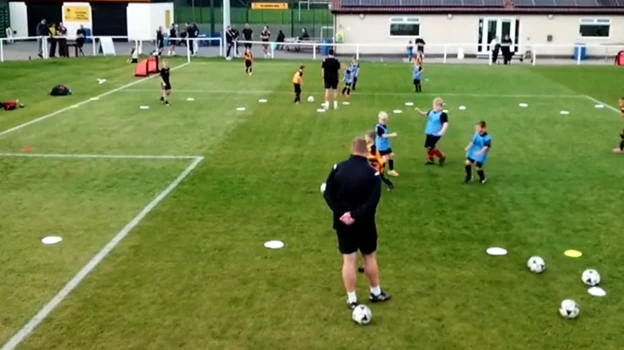
England’s new 3v3 football format for children under seven is designed to give young players more touches of the ball, encourage creativity and improve their decision-making. But could this small change help shape the future of English football?
English football is introducing a new approach to developing young players, with three-a-side football becoming the starting format for children under seven.
The change aims to help children become more comfortable with the ball, improve their skills and enjoy the game from an early age. It could also influence how future generations of English footballers learn to play.
The debate comes after England manager Thomas Tuchel highlighted ball possession as an area where English players could improve compared with teams from countries such as Spain, Argentina and Brazil.
His comments have raised an important question: can changes at grassroots level help England produce players who are more confident on the ball?
What Is 3v3 Football?
Three-a-side football, commonly called 3v3, is a simplified version of the traditional game. Instead of having 11 players on each team, each side has just three players.
Under the Football Association’s new approach, children under seven move from the previous five-a-side format to 3v3 football.
The format removes goalkeepers and referees, allowing children to take a more active role in the game. Players are encouraged to manage the game with guidance from their coaches, while learning how to play fairly and safely.
With fewer players on the pitch, each child has more opportunities to touch the ball, pass, dribble, defend and attempt to score.
The change follows research conducted by the Football Association in partnership with Liverpool John Moores University. The research examined hundreds of youth matches across different age groups to understand how children participate in small-sided football.
The central idea is simple: children learn by being involved. More time on the ball can give them more opportunities to practise skills, make decisions and build confidence.
Why Is England Introducing 3v3 Football?
One of the main goals is to improve the quality of football development from an early age.
In larger matches, some young players can go long periods without touching the ball. Children who are less confident may spend much of their time watching others play instead of developing their own skills.
Three-a-side football is intended to reduce that problem.
With fewer teammates and opponents, players must make decisions more frequently. They need to decide when to pass, when to dribble, how to defend and where to move to create space.
The format can also encourage children to take responsibility rather than depending on one or two stronger players to control the game.
These skills are important because modern football requires more than physical strength and speed. Players must also be comfortable receiving the ball under pressure, recognising opportunities and making quick decisions.
However, whether the new approach will improve the performance of England’s senior national team remains to be seen. It will take years to determine how much influence the change has on players as they grow older.
What Do Football Coaches Think About the Change?
Although the idea has clear benefits, some grassroots coaches have raised practical concerns about how the new format will work.
Running several small matches at the same time can require more pitches, volunteers and adult supervision. Clubs that already depend on a small number of coaches and parents may find the arrangements challenging.
Safety is another concern. Without a referee on each pitch, coaches and supervising adults must help children understand the rules, recognise dangerous challenges and learn how to play fairly.
Some coaches have also questioned whether 3v3 football will benefit every child equally.
For example, a confident player who is more advanced than their teammates might dominate the game by taking most of the shots. Less experienced children could still struggle to get involved if coaches do not encourage everyone to participate.
These concerns suggest that the success of the format will depend not only on the number of players but also on how well the sessions are organised.
Coaches will need to create an environment where every child gets opportunities to handle the ball, make mistakes, learn and improve.
Are Children Enjoying the New Format?
For many young players, the appeal of 3v3 football is easy to understand.
With fewer opponents to get past and more chances to attack, children can find it easier to dribble, create scoring opportunities and become involved in the action.
The simplified format may also help children who previously spent much of their time in one position.
Instead of remaining in goal or playing a limited role, youngsters can experience different parts of the game. They can practise attacking, defending, passing and moving into space.
Parents may also welcome the opportunity for their children to develop a broader understanding of football.
However, not every child will adjust immediately. Some youngsters who are familiar with traditional five-a-side matches may need time to understand the new format.
That is why patience and encouragement from parents and coaches will be important during the transition.
At this age, the priority should be helping children enjoy football and develop a lasting interest in the sport rather than placing too much pressure on results.
Could 3v3 Football Affect Goalkeeper Development?
One of the main questions surrounding the new format concerns goalkeeper development.
Because 3v3 football does not use goalkeepers, children do not get the same early experience of defending a goal with their hands.
Some coaches may worry that this could make it harder for future goalkeepers to develop the skills needed for the position.
However, the Football Association’s approach is based on the idea that children do not need to specialise in goalkeeping at such an early age.
The 3v3 format is intended to be a temporary stage, with children returning to formats that include goalkeepers as they progress through the age groups.
In the meantime, they can develop other useful abilities, including positioning, movement, blocking, anticipation and controlling the ball with their feet.
These skills can also benefit children who eventually choose to become goalkeepers.
The key question is whether the benefits of allowing every child to participate more actively outweigh the loss of early goalkeeper-specific practice. The long-term impact will need to be assessed as the children progress.
Could 3v3 Help England Produce Better Footballers?
The biggest question is whether the change can help address some of the concerns about English football’s technical development.
England has produced many talented players, but developing footballers who are comfortable keeping possession, controlling the pace of a match and making decisions under pressure remains an important part of youth development.
Small-sided football can create more opportunities to practise these skills because players are regularly involved in the action.
It may also encourage creativity. When children have fewer teammates to rely on, they often need to find their own solutions to problems on the pitch.
Nevertheless, 3v3 football is not a guaranteed solution to England’s challenges. Coaching quality, access to facilities, the standard of youth development and opportunities to play as children grow older will all remain important.
The format should therefore be viewed as one part of a wider approach to developing better footballers rather than a quick fix for the national team.
What Happens Next?
The new 3v3 format represents a change in how England introduces its youngest players to organised football.
Its success will depend on whether children remain engaged, receive enough individual attention and develop skills that help them progress to larger formats.
England is not alone in exploring three-a-side football for young children, with similar approaches used in several other countries.
Over time, coaches and football officials will be able to assess whether the format improves participation, technical ability and overall player development.
For now, the priority is to give children more opportunities to play, learn and enjoy football.
If the approach helps young players become more confident, creative and comfortable on the ball, it could become a valuable foundation for the next generation of English footballers.
But changing the future of English football will take more than reducing the number of players on a pitch. It will require good coaching, consistent support and a development system that allows young talent to flourish.