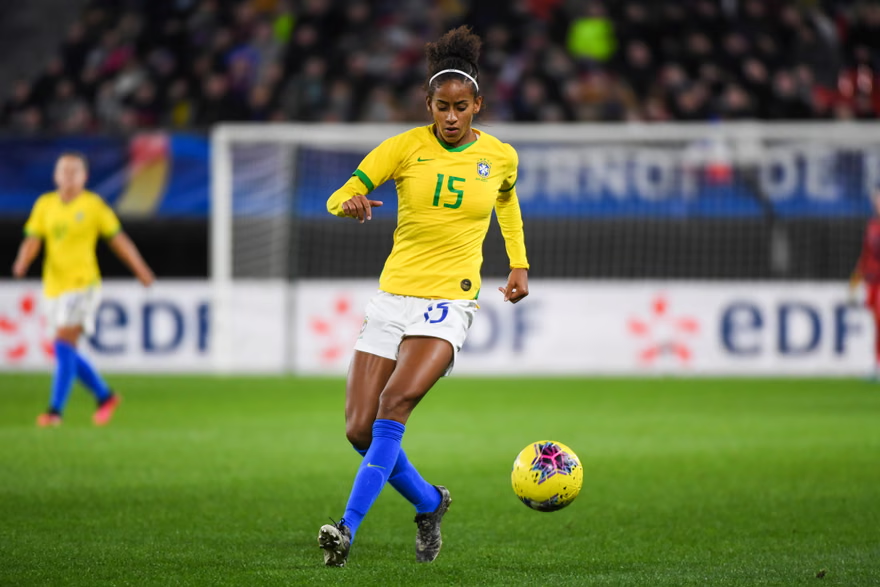
Brazil’s upcoming presidential election could have a major impact on the future of women’s football, with players, historians and sports advocates warning that government policies will play an important role in the development of the women’s game.
As the country prepares to host the 2027 FIFA Women’s World Cup, questions about funding, gender equality, racial discrimination and opportunities for young female players have become increasingly important.
Brazilian footballers Carlinha and Tayla Carolina have spoken publicly about their political concerns, highlighting how decisions made by the next government could affect not only football but also the lives of women and girls across the country.
Brazilian Footballers Speak Out Ahead of the Election
The debate gained attention after São Paulo won the Brazilian Women’s Championship, also known as the Brasileirão Feminino, following a 3–2 aggregate victory over Corinthians.
After the final, goalkeeper Carlinha used a televised interview to express her opposition to the return of former president Jair Bolsonaro’s political movement.
Her comments were influenced by personal experiences during the COVID-19 pandemic, when she lost her grandmother. Carlinha has spoken about the difficulties families faced during that period and why the country’s political direction matters to her.
As a journalism student and professional footballer, she believes public figures have a role to play in important national discussions.
Her comments reflect growing political engagement among female footballers, many of whom believe that government decisions can influence their careers, rights and opportunities.
Tayla Carolina Highlights Inequality and the Struggles of Working Families
Brazil international Tayla Carolina has also used her public platform to discuss social inequality and the experiences of working-class families.
Tayla, who comes from a modest background and attended public schools, has spoken about the sacrifices made by her mother and grandmother, both of whom worked as cleaners.
Her story highlights the difficulties faced by many Brazilian families, particularly those from disadvantaged communities.
She has also expressed support for policies aimed at improving access to public services and creating better opportunities for ordinary citizens.
For Tayla, the discussion goes beyond party politics. She believes the experiences of footballers from working-class backgrounds give them a responsibility to speak about issues affecting the wider population.
These concerns are especially relevant to women’s football, where players often face financial difficulties, limited resources and fewer professional opportunities than their male counterparts.
Financial and Mental Health Challenges in Women’s Football
The future of women’s football in Brazil is also linked to the wider challenges facing female players around the world.
According to a study cited in the original report by the international players’ union FIFPRO, nearly half of the 800 professional female footballers surveyed had considered retiring early because of psychological and financial pressures.
The findings highlight the difficulties many players experience while trying to build sustainable careers in the sport.
Although women’s football has gained more attention in recent years, concerns remain about pay, working conditions, investment and long-term career security.
In Brazil, government support could help address some of these challenges by encouraging clubs to invest in women’s teams, improving development programmes and expanding opportunities for girls who want to become professional footballers.
Why the 2027 FIFA Women’s World Cup Matters
Brazil is preparing to host the 2027 FIFA Women’s World Cup, a tournament that could provide a major boost to the development of women’s football across the country.
Hosting a global competition can attract investment, increase public interest and encourage more young people to participate in the sport.
However, football advocates argue that the benefits should continue long after the final match.
Brazil’s World Cup legislation, approved in June 2026 according to the source report, establishes responsibilities for government ministries, football authorities, state federations and clubs in supporting the tournament and its long-term impact.
The plans include four major areas of development:
- Expanding access to football: Helping more girls and women participate in the sport and remain involved.
- Professionalising the game: Improving development pathways and making women’s football a more sustainable career.
- Fighting discrimination: Addressing gender-based and racial discrimination in football.
- Strengthening the sport’s economic and cultural value: Using the tournament to create wider opportunities for the game and its communities.
Supporters believe these commitments could help Brazil build a stronger and more inclusive football system.
However, they are concerned that a change in government priorities could affect the implementation of these plans.
How Different Political Priorities Could Affect Women’s Sport
The election has brought different approaches to women’s sport into focus.
The source report notes that President Luiz Inácio Lula da Silva’s government has included support for the Women’s World Cup and the development of the women’s game in its plans.
By contrast, the reported sports proposals associated with Bolsonaro’s political camp emphasise the eligibility rules for women’s sporting categories and opposition to what it describes as ideological agendas, without making the same explicit commitment to the 2027 tournament.
These differences matter because government policy can influence how funding is allocated, how sporting programmes are developed and which initiatives receive institutional support.
Brazilian women’s football advocates fear that a government less committed to the World Cup’s development plans could weaken efforts to improve opportunities for female players.
At the same time, the eventual impact will depend on the policies adopted, the funding provided and how effectively existing commitments are implemented.
Women’s Football Has a Long History of Fighting for Recognition
The political debate surrounding women’s football in Brazil is not new.
According to Brazilian football historian and author Aira Bonfim, the women’s game has a history stretching back more than a century, with early examples of women playing football recorded in the country in 1915.
Women’s football has faced significant barriers throughout its history. One of the most notable was a ban that prevented women from playing the sport in Brazil for decades, from 1941 until 1979.
During that period, female players faced restrictions and social attitudes that discouraged their participation in football.
Historians say these experiences demonstrate how sporting opportunities can be shaped by broader political, racial, economic and gender inequalities.
The history also helps explain why many players and advocates see the upcoming World Cup as more than a sporting event. They view it as an opportunity to address long-standing barriers and establish a stronger future for the women’s game.
Why Government Support Matters for Young Girls
For many young girls in Brazil, football represents more than a chance to play professionally. It can also provide access to education, community support and new opportunities.
Kely Nascimento, the daughter of football legend Pelé and executive director of the Nascimento Foundation, has highlighted the difficulties facing female athletes who lack the financial security enjoyed by some of their male counterparts.
Many Brazilian footballers come from low-income neighbourhoods and communities where access to opportunities can be limited.
Investment in women’s football can help clubs and community organisations create better training facilities, coaching programmes and development pathways.
It can also help more girls remain in education while pursuing their sporting ambitions.
However, advocates warn that these opportunities require sustained support. A successful World Cup alone cannot solve the structural problems facing women’s football if investment and development programmes disappear after the tournament.
Social Media Is Giving Female Footballers a Stronger Voice
Social media has made it easier for footballers to speak directly to supporters and participate in national debates.
Although female players in Brazil generally have smaller online audiences than leading male footballers, their influence is growing.
Carlinha and Tayla Carolina have used their visibility to draw attention to political choices, social inequality and the future of women’s sport.
Their involvement also reflects a wider change in football, where players increasingly use their platforms to discuss issues beyond the pitch.
For women’s football, this visibility could help attract supporters, encourage public discussion and place greater pressure on institutions to address longstanding problems.
What the Election Could Mean for Brazil’s Football Future
The outcome of Brazil’s presidential election could influence the direction of women’s football at a crucial time, particularly as preparations continue for the 2027 FIFA Women’s World Cup.
The main issues include government investment, professional opportunities, equality, discrimination and the long-term development of the sport.
A government that maintains and implements strong development commitments could help build on the attention generated by hosting the World Cup. Changes in priorities, however, could create uncertainty for programmes designed to expand participation and improve conditions for female players.
The election is therefore important not only to professional footballers but also to community organisations, young athletes and families who see sport as a path to opportunity.